
I mentioned on my Polish Trace Around the World Facebook page Benedict the Pole, who explored East before Marco Polo. This is his story.
I think that my fascination with the Age of Exploration began with the books about Tomek Wilmowski’s adventures, written by Alfred Szklarski. In each of the volumes, Tomek searched for news about Poles in the part of the world they were visiting and presented them to his comrades. With time I switched to the explorers’ descriptions, starting with the Portuguese activities in the fifteenth century. I put great emphasis in my search on the anthropological and ethnographic aspect. I was interested in the way of life of different peoples, including the simplest activities. Often indigenous peoples, referred to by Europeans as savages, managed to cope perfectly without the great gifts that our civilization has to offer. I will not even mention the influence and the role of the Church.
And what’s the Polish link to the Age of Exploration, because that’s what it was supposed to be about?! I will write a few words today about the first Polish traveller. But we have to go back in time a little bit, some 800 (eight hundred) years…
I’m going to tell you about Benedict Polak (Benedictus Polonus). This is what he’s called in the sources it’s not even known if this was his real name or if it was a name which he adopted when he entered the Order of Friars Minor (Franciscans). Little is known about his youth. He was born in Wielkopolska (Greater Poland) around 1200. In 1236, after giving away everything he owned, he joined the Franciscans who in the same year founded the first monasteries in Poland.
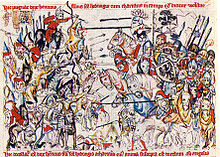
Battle of Legnica
Five years later, there was a battle near Legnica between Polish knights, crusaders and Mongols. As you know, Christians lost and Henry II the Pious (1196 / 1207-1241) had lost his head (literally). Concerned about this defeat, Pope Innocent IV decided to send a mission to the Mongolian Khan to convert him to Christianity and propose an alliance against Muslims in the Holy Land. In addition, he ordered his emissaries to record observations regarding the location of the Mongolian state, the system of governance and customs. So it was a journey of discovery in the full meaning of this word. At the head of the papal mission was the legate John of Piano Carpini (1182-1252), then an old man. He set off from Lyon in 1245 and Benedykt Polak joined him in Wroclaw. In Poland, the expedition had also equipped itself with in gifts for the khan. They were accompanied by brother Stefan from the Czech Republic. They came from Poland through Wlodzimierz Wolynski (Volodymyr-Volynskyi) to Kiev, from where they set out on 4 February 1246 to Kaniow and from there they reached the first large Tatar camp. In Kiev, Stefan resigned from his further trip. After obtaining escort and translators, they set out for Batu Khan’s (Genghis Khan’s grandson) camp, in the vicinity of Astrakhan near the Caspian Sea. After giving presents ( or bribes 🙂) they set off on 8 April further to the east passing the Aral Sea and then along the Syr Darya. The travellers account lists cities such as Jangikent (Yanghikand), Ornas (Otrar), and Barchin (Barkhalikend). In this way, Benedykt Polak became the first Pole who set foot in Asia (although it can not be ruled out that some Polish prisoners have been driven into this area earlier). Passing the mountains of Tien Shan from the north, monks came to Mongolia on July 22 and after three weeks of travel they reached the summer residence of the khan over Orchon (in northern Mongolia) called by the monks the Syra-Orda. Whether it was Karakorum or was the residence near Karakorum, it is difficult to settle. I haven’t unfortunately read the original report in which the emissaries wrote that they were not in Karakorum.
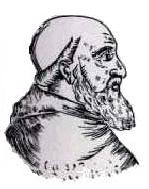
John di Piano Carpini
They spent four months at the court of the great khan, being among others witnesses of the solemn enthronement of the great Khan, Güyük. The ceremony lasted seven days and the friars delightedly described the riches they had seen. They were also personally received by the ruler during their stay at the court.
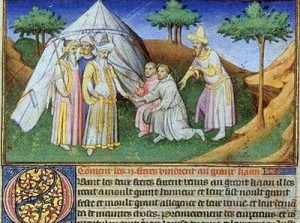
Gifts for the Great Khan
On 13 November 1246, they set off on their return journey. They were provided with the khan’s reply to the Pope’s letter. In his letter, Güyük-khan called on the Pope and all the rulers of Europe to come and pay homage to him. As you can guess the khan refused to convert to Christianity 😦
On 9 May 1247, they returned to the Batu Khan camp and a month later they came to Kiev. The road from Kiev to Lyon took them over five months. Every court wanted to host famous monks along the way. In Europe Benedict dictated his report, which was later incorporated into the Carpini’s report (Historia Mongalorum). It was not until 1965 that Benedykt Polak’s Historia Tartarorum was published in Yale. Discovered by chance in an antique shop, it was not known before. This work contains a huge amount of information about the Mongol empire – history, law, religion, way of waging war. In addition to this work Benedict left a shorter relationship – Itinerarium, containing amongst others khan’s letter to the pope.
Carpini died in 1252 as the Archbishop of the city of Bar in today’s Montenegro.
Nothing is known about Benedict except that in 1252 he was the guardian of the monastery in Krakow and that he testified as a witness to a miracle in the canonization process of Bishop Stanislaw of Szczepanow. This year is also sometimes given as the date of his death. I found information that he died in 1280 but that would mean a huge gap in his life between 1252 and 1280. Considering how much his health had to be damaged after returning from the mission, I would be inclined towards an earlier date.
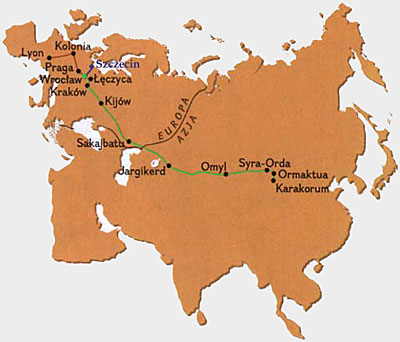
Map of the Benedict the Pole’s journey
What the monks did was unheard of. They travelled around 20,000 kilometres. They were the first Europeans to reach the Mongol Empire. Considering the contemporary realities, they did the impossible. That’s how it was received in Europe.
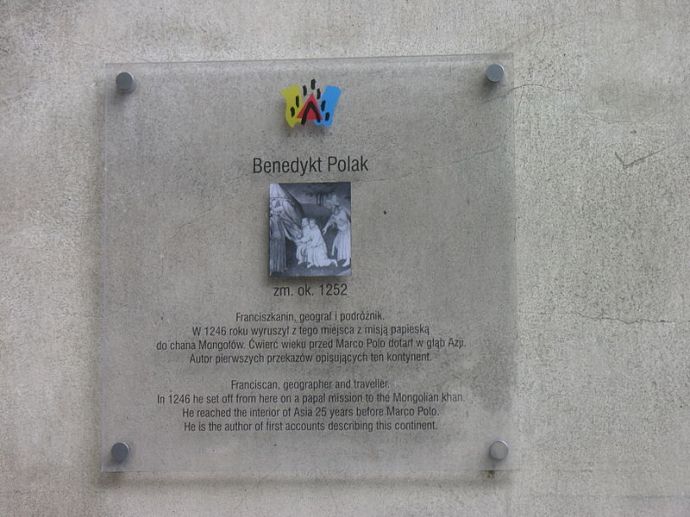
Plaque commemorating Benedykt Polak at the church of Saint Vincent in Wroclaw
Bibliography:
W. Słabczyński, Polscy podróżnicy i odkrywcy, Warszawa 1988, 428 pages.
http://benedyktpolak.org/benedykt.php
http://www.franciszkanie.pl/news.php?id=5403

 Polish traces around the world