A few days ago, when I posted about Jozef Kosacki on my blog’s FB page I wanted to add a link to the actual entry on my blog and I realized that I haven’t translated it to English 😦 Here it goes then.
The fact that the Poles “broke” the Enigma code is probably widely known but we have one more invention that saved lives of thousands but let me build up the excitement first.
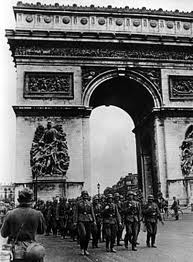
German parade on the Champs-Elysées
After the fall of France in June 1940, almost immediately units of the 1st Polish Corps in Great Britain began forming. The Polish units were tasked with defending the east coast of Scotland. At that time there was still a danger of a German invasion from Norway. In 1941, during a routine reconnaissance operation, patrol of the 10th Armoured Cavalry Brigade entered a minefield and the losses suffered by the unit (all soldiers torn apart) had a huge impact on today’s post hero.
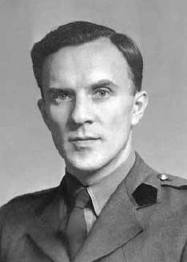
Jozef Kosacki
Józef Stanisław Kosacki was born on April 21, 1909 in Łapy (near Białystok). He graduated from high school in Czestochowa and then went to the Warsaw University of Technology, where he graduated in 1933 with an electrical engineer diploma. After graduation, he trained at the Sapper (pioneer) Training School in Modlin (a few years before Ryszard Bialous) and had his practical training in Nowy Dwór Mazowiecki. From 1934 until the outbreak of war he worked with telegraph repeaters at the State Institute of Telecommunications in Warsaw.
On 4 September he volunteered and served in the communications unit which set up a radio station through which President Stefan Starzyński spoke so fierily.
He and his unit went to Hungary where he was interned. He soon escaped from the camp and using fake documents got through Italy to France. France did not turn out to be very brave so Kosacki went to Great Britain where he served in the Communication Training Centre in Scotland (first in Dundee and later in St. Andrews). During his service in Scotland the mentioned above accident occurred. Our hero decided to do something about it. Already before the war he noticed that the amplifiers reacted differently to metal and so the idea began to form in Kosacki’s mind.
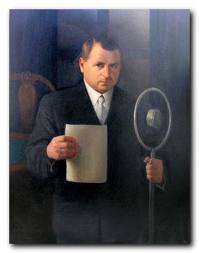
With his speeches in September 1939, President Starzyński raised the spirit in the nation
My connection to Dundee is limited to the admission ticket to… the public toilet at the bus station, purchased in 2004. 🙂
Within three months, with the cooperation of Sergeant Andrzej Garboś, Kosacki developed a mine detector. This coincided with a competition announced by the British Ministry of Supply for hand-held mine detector. The project to find the highest number of coins scattered in the grass would win the competition. Kosacki’s mine detector found them all in the shortest time and beat the British designs. Mr Kosacki didn’t patent his invention and donated it to the British Government without charge – he wanted to prevent terrible accidents, not to make money.
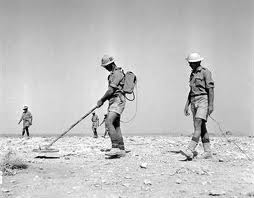
Mine detector in action in Africa
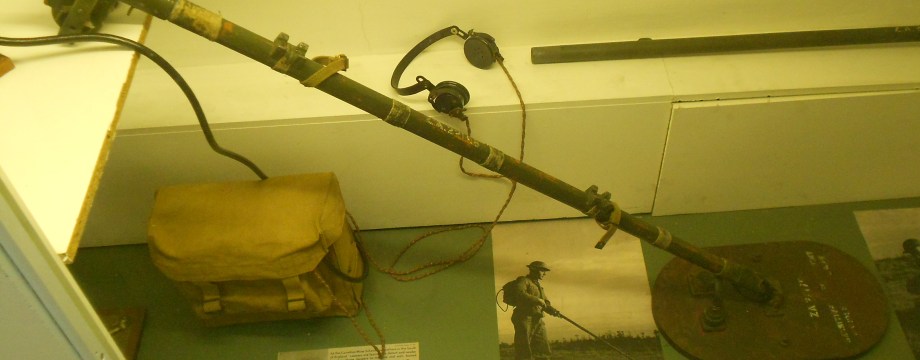
Polish Mine Detector Mark 1 was put into production and the first 500 units were used in the second Battle of El Alamein in the fall of 1942. Kosacki’s mine detector was also produced by Americans and Russians and was used by the British Army until 1995.
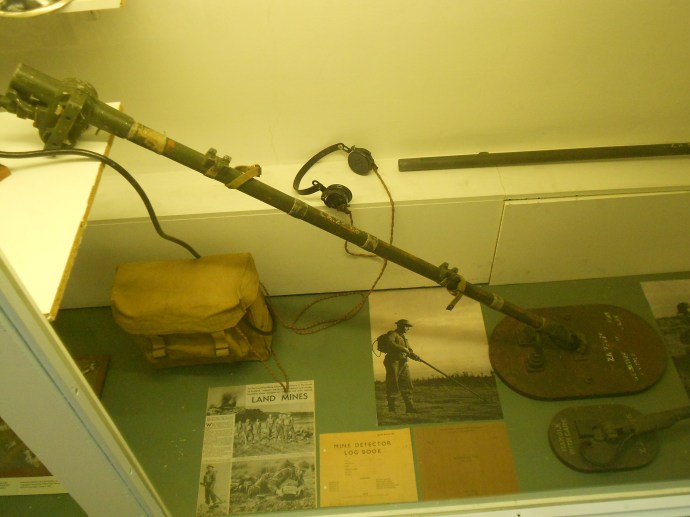
Polish Mine Detector – this one can be seen at the Sikorski Museum in London
Kosacki remained in England until 1947, overseeing the production of mines and later working with the Royal Navy. Then he returned to Poland where he again worked at the State Institute of Telecommunications in Warsaw, obtaining a degree of docent (a person with right to teach at university). From 1956 to 1976 he worked at the Institute of Nuclear Research. In 1964 he became an associate professor at the Military Academy of Technology.
Józef Kosacki died on 26th April 1990 and was buried in Warsaw. Only after 1989 did the truth about Kosacki and his invention begin to come out. During the war the name of the inventor of the detector was changed so that the Germans could not get revenge on his family and after the war the communists were not interested in his achievements in the West. It is hard to say how many thousands of people’s lives Kosacki’s invention has saved.
In 2005, the Military Institute of Engineering Technology in Wrocław adopted the name of Professor Józef Kosacki. That’s where the only prototype of the Polish mine detector and Kosacki’s uniform from the war is being kept.
Bibliography:
http://www.mazowszelok.pl/postacie-historyczne/468-wykrywacz-min-prof-jozef-kosacki

 Polish traces around the world