
Flag Day, May 3rd Constitution Day are a very good reason to write something. Today’s topic is not new, a doctoral dissertation has been written on the subject. Let me tell you then a few words about my short but eventful visit to Sweden.
I started my first visit to my girlfriend’s country in her hometown, Mariefred. Seemingly normal, sleepy town on the shores of Lake Mälaren but surprisingly with many Polish traces.
But let’s start from the beginning. In September 1939 Polish Navy had 5 submarines, three of Wolf class (built in France), ORP (Okręt Rzeczypospolitej Polskiej – Vessel of the Republic of Poland) Wolf (Wilk), Lynx (Ryś) and Wildcat (Żbik) and two of Eagle class (built in the Netherlands) – ORP Eagle (Orzeł) and Vulture (Sęp). Another two were ordered by Polish Navy but had not been completed on time.
All ships according to Plan Worek (Sack) were deployed in the area of Hel Peninsula in order to prevent German Navy from landing or shelling the coastal fortifications. “Tethered” to their sectors, lacking the needed equipment (submarines were literally blind and deaf when attacked), not allowed to attack smaller vessels made their actions quite fruitless (ORP Vulture attacked German destroyer but failed to hit it) attracting a lot of attention from German ships.
Lack of successes, high activity of the enemy and the growing list of faults made one ship after another to leave their sectors and try to get to UK. Another option was to go to neutral Sweden.
Ships’ faults made three of the submarines go to Sweden where they were interned (Vulture on 17th September, Lynx on 18th September and Wildcat on 25th September). Wolf and Eagle managed to get to the UK. The ships were disarmed, safe floats deposited at Handelsbanken and were used later for seamen and officers living expenses. In addition to money from the ships the crews could use money deposited by Polish Government before the war. Those funds were supposed to be used to purchase the Bofors guns. Apart from three submarines a boat Batory and sailing ship Dar Pomorza (The Gift of Pomerania) were also interned in Sweden. All vessels remained in Sweden throughout the war.
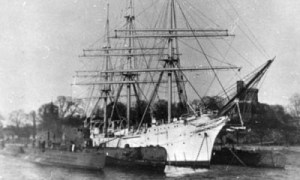
Dar Pomorza and the submarines in Stockholm
After Eagle’s daring escape from Tallinn the Swedish authorities tightened security measures. Crews were embarked but any trips to the city took place in formation and under heavy guard. After Denmark and Norway invasion ships were re-armed and crews put on standby because Sweden feared that Germany would attack. As they still remembered Eagle’s escape ships were left without fuel as Swedes were afraid that Poles would use the first opportunity to escape.
The danger passed and the ships were disarmed again and transported to Lake Mälaren. Crews were placed in a camp in Mariefred and submarines moored near shore.
Conditions were tough, temperatures in the winter dropped to -35 degrees Celsius. Seamen were first kept on-board and only later were transferred to a camp on the mainland. For a few sailors it was too much and unfortunately they died. They are buried in a small cemetery in the town centre. After a difficult beginning (quite many Nazi supporters lived in Sweden) Mariefred’s citizens started to warm up to Polish seamen. Poles were helping in the field and with felling the trees. As mentioned before living expenses were covered by the money deposited in bank, there was no help from Swedish Government.
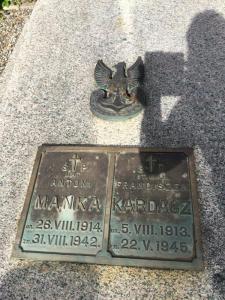
Antoni Manka was the first one to die
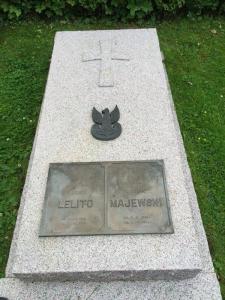
Grave of another two seamen who didn’t survive

This is were more or less the camp was located. In the background on the left you can see narrow-gauge railway station. On the right is the baths used by our sailors and Lake Mälaren
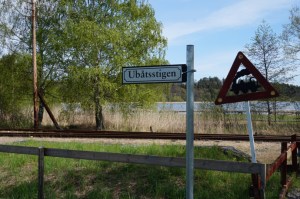
Literally Submarine Path. Sign warning of narrow-gauge railway
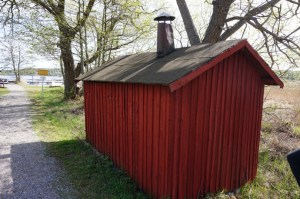
“Luxurious” baths

Boiling water for almost 200 sailors must have been time-consuming
Sailors spent the entire war in Sweden. After the war all vessels were returned to communistic Poland. Out of 16 officers only Lieutenant Commander Wladysław Salamon decided to return to Poland. Most of the seamen emigrated to England, a small group went back to Poland and 71 stayed in Sweden, a few of them in Mariefred including bosman mat (Petty Officer Third Class) Wladysław Sloma (who was a local “celebrity” – my girlfriend’s brother knew very well who “Wadek Sloma” was). He had done a lot to commemorate Polish seamen but he also was an important person in local community (it was his idea to launch the narrow-gauge railway which is a very popular tourist attraction during summer). Through interviews, talks in schools, opening of an exhibition about Polish seamen in Vaxholm, funding a small monumet in Mariefred Mr Sloma served his country even after the war and for those actions he was awarded the Navy Cross of Merit in 1999 and in 2008 the Order of Merit of the Republic of Poland. Unfortunately he died later that year at the age of 95.
Citizens of Mariefred know the story of Polish seamen, in a local bookshop you can buy a book in Swedish about it. My Swedish is still very limited but next time I’m in Mariefred I’ll purchase it even if only for the photographs.
There are more Polish traces in Mariefred but this is a topic for another post in which we’ll go back in time a few centuries.
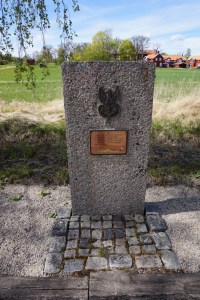
Monument funded by Mr Słoma, between Marielund station and seamen’s baths
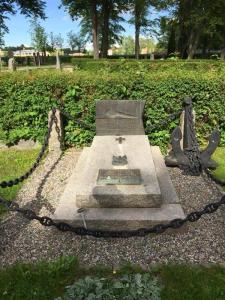
Monument in honour of dead Polish seamen located in the cemetery in Mariefred
Bibliography:
http://www.poloniainfo.se/artykul.php?id=509
https://en.wikipedia.org/wiki/Polish_Navy
http://historia.trojmiasto.pl/Szwedzka-epopeja-polskich-podwodniakow-n80215.html

 Polish traces around the world
There u r!!! Nice to finally c the Dad of Tom, James and August. Enjoy your holiday.
Pingback: Gripsholm castle | Polish traces around the world
Nice to see this story continues and expands as new writers enter the scene.
A.G. Sadowski (son of Sub Lieutenant Kazimierz Sadowski and former resident of Mariefred 1941-1945.
ag@agsadowski.com
Young generation (maybe not so young in my case 😉 ) remembers. I’ll light a candle in Mariefred every time I visit